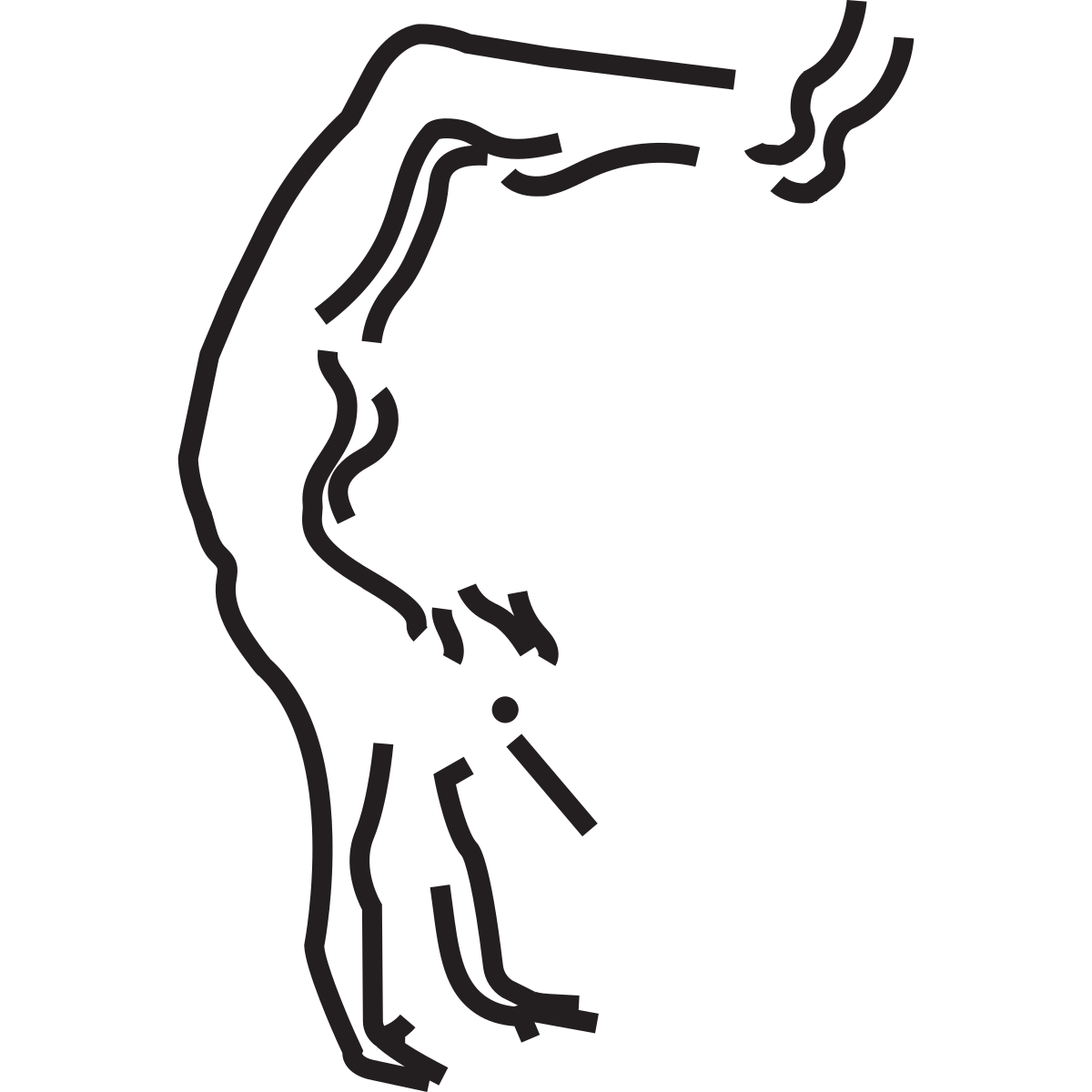
Feet have walked over tracks, and upon their soles, they carried dust. The dust, by imprinting a shape onto a surface, left a new mark. Could dust be called a "thing"? Or perhaps a collection of things? A collection of dots, fluffs, crumbs? What, then, do I carry after brushing against a wall or an idea? A ball of words, of images, a few tangled threads. A skein of remembered events, lines that are extensions of pencil strokes. A plasticine lump, a scrap, something that failed, yet is there—sitting in the corner, watching. Odradek is a character created by Franz Kafka in the story "The Cares of a Family Man" (Die Sorge des Hausvaters). It is a figure whose every aspect is doubtful and debatable. The traits of Odradek described by the narrator are either mutually exclusive or seem blurred, erased. Ultimately, it is unknown; it cannot be objectively established who or what Odradek is or what they look like. We know a little about their lifestyle: that they loiter underfoot, that they sit in the corner and peek out, that they roll down the stairs, that they inhabit attics and stairwells. The exhibition "Moving Things" (Przenoszenie rzeczy) is an image from Odradek’s point of view. The viewpoint of the scrap, the apostate, the leftover. Odradek is the brother or sister of the stranger (obcy). They are a ball of thread, a rag, a bundle, a tangle. Someone erased, "the other," pushed to the margins—but also the one who sees, collects, attracts; the one who is the image of what is. Because they have just wandered in. They are peeking. "Moving Things" is a change of arrangement and a daily toil. It is the revolution of everyday life. Day after day, I move things, and that is what I do. My life is the moving of things. Finally, "moving things" is a change of context. I take an object that conventionally belongs to the order of theater and place it within the order of visual arts. I shift a museum object from the field of design history and place it next to an oil painting. What is a work of art? What is a prop? What is a piece of furniture? When is an image created? The imagery of "Moving Things" is composed of paintings by Luka Woźniczko. These are dense, stifling paintings depicting mangled bodies, bulging eyes, decontextualized, terrifying teeth. These are portraits of entrails, tangled from pieces of externality. The titles suggest family histories, moments of transition, personal emotional experiences. Mikołaj Małek’s assemblages are imprints of hand gestures and toothbrushes. Alongside these imprints are trees from a TT-scale model train set and a 1.44 MB floppy disk. The assemblages evoke specific events, enchanting time and teleporting us to the moment when a boy looks at the sun through the filter of a floppy disk, or when the boy's father returns from Minsk and brings back a toothbrush from the sleeper train. These seemingly minor events are points that, when pressed, trigger a trapdoor. The trapdoor plunges the viewer into the dungeon of childhood. Once again, you are alone, separate, small. The sun is a dangerous star which, despite being so terribly distant that we will never reach it, can take away one's sight and burn the body. The toothbrush brought by the father is an intimate object close to the body, something the boy bashfully takes from his father. It is not a souvenir from a trip; it is something the father surely didn't think about, something he might have taken unwittingly instead of throwing it away. The boy performs a shameful gesture and, as an adult, transforms it into a spell. Arek Tworus’s collages are classical compositions made by compiling fragments of photos previously cut from books and magazines. What do they show? Figures on the edge, figures peering into the depths, people presenting cats at a cat show while in the background the sea swallows the land and floods houses. An elderly couple leans over a waterfall as if over a grave; hunched, they walk with flowers. A cat-man looks at the viewers. Squatting riders race on horses, bogged down in shadows settling on the surface of the water. A crocodile served as a prop/costume in a play directed by Arek Tworus with scenography by Przemek Czepurko. The crocodile accompanied the moment of the protagonist’s transformation. This crocodile has no legs; it is more of a "snake-o-dile"—a snake with a crocodile's head. The protagonist dons its skin, thus appearing as someone else; it is one of his "selves." A chair designed by Walter Funkat is today a museum object, but once, at its inception, it was the crystallization of ergonomic thought in the spirit of the Bauhaus. The chair will play the role of a support and a seat, as well as a partner to the musician Hubert Zemler. Hubert will perform a solo snare drum concert on the second day of the exhibition. The snare drum and the seat are the elements of limitation chosen by the artist to express himself just as simply and economically through the economy of form. Hubert's music on the snare drum is a conceptual act close to the Bauhaus school. A musician operating with a very wide range of instruments consciously limits his means. The order of things is a contract. The exhibition "Moving Things" is, in a sense, a breaking of that contract—an attempt to look at the encounter and the gaze of the "other." The Odradek, the apostate, the leftover.
Anna Maria Karczmarska
Artists:
Przemek Czepurko, Walter Funkat, Mikołaj Małek, Arkadiusz Tworus, Luka Woźniczko, Hubert Zemler
Curator:
Odradek