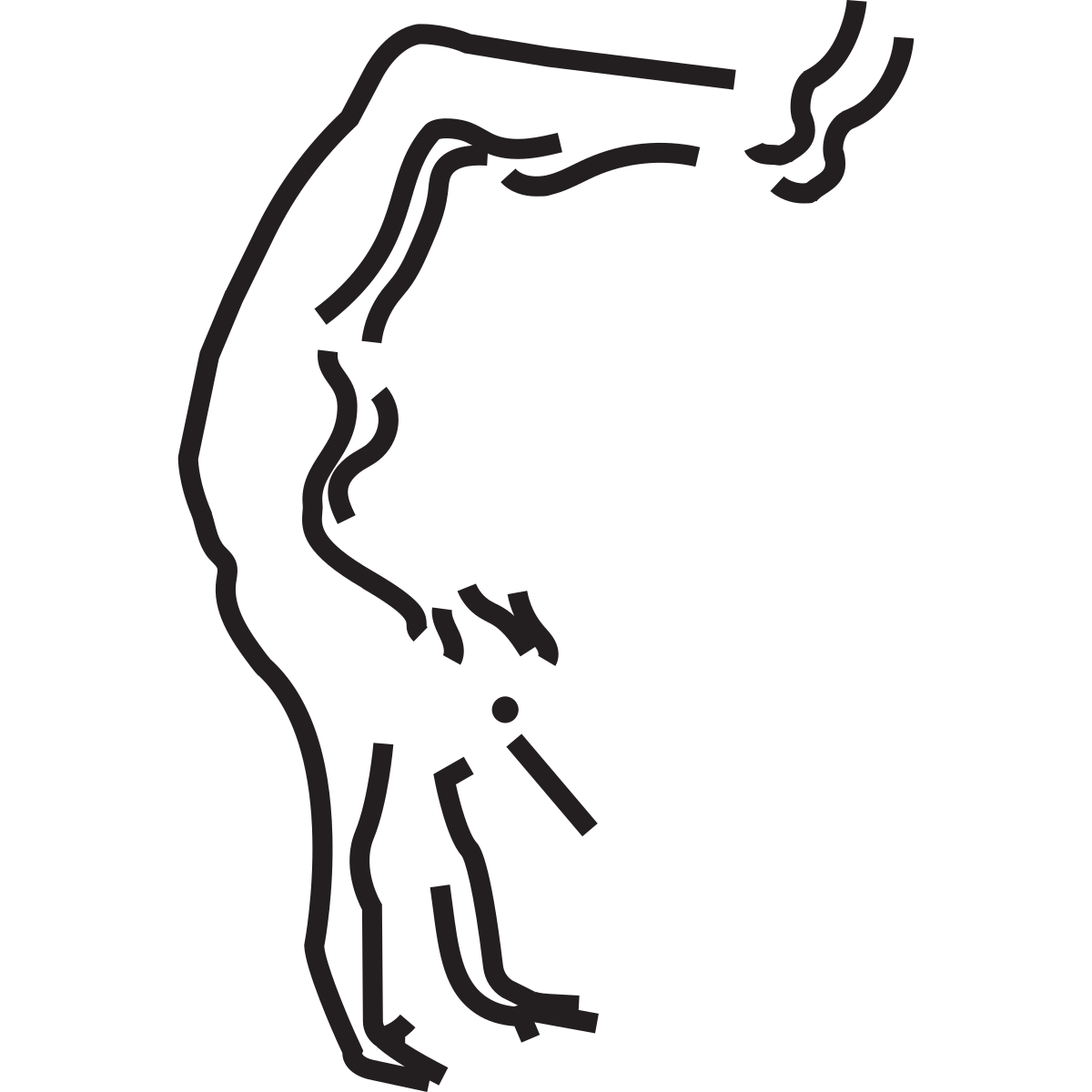
An exhibition by the artistic duo Anna Maria Karczmarska and Mikołaj Małek, scenographers and creators of performance installations. These artists have been collaborating for over a decade, co-creating scenographic objects and working with directors, dramaturgs, and actors to produce numerous stage designs for theaters throughout Poland. In the exhibition "Pulcinella in a Foreign Language," the artists will present scenographic and art objects in new contexts, inspired by the character of Pulcinella from the Italian commedia dell'arte and Giorgio Agamben’s text "Pulcinella: Or Entertainment for Children." The exhibition will encompass scenography, painting, performance, sculpture, and costumes.
The exhibition will take place at the temporary premises of Obcy język at ul. Grodzka 7, 3rd floor, in Szczecin at 6:00 PM.
January 30, 2026
6:00 PM
opening of the exhibition "Pulcinella"
Artists:
Anna Maria Karczmarska, Mikołaj Małek
Curator:
Anna Maria Karczmarska
Curatorial text:
Szymon Piotr Kubiak
Coordination and guided tours:
Tosia Pilinow
As Benedetto Croce stated at the end of the 19th century, Pulcinella (Pulcinello, or in dialect Policinella, Polecenella, or Pullecinella) is not so much a clearly defined stage type as "a collection of characters linked together only by a name and, to some extent, a black half-mask, a white shirt, and a pointed hat." To this description, let us add the hooked beak as an etymological souvenir: in Italian, pulcino means "chick," thus Pulcinella hatches from an egg, often moves in a squatting position, shifts body weight to one leg, winces, hops, and even flaps their arms like a bird. This central persona of commedia dell’arte is characterized by total non-binary fluidity and a multiplicity of representations. They are both male and female, "stupid and highly intelligent, ridiculous and mocking, clever and incompetent, wise and insane – all of this at random, without any principle of artistic unity." They rarely appear alone; usually accompanied by twins, for – as the contemporary philosopher Giorgio Agamben notes – by avoiding identification with a single subject, they condemn themselves to constant and independent (via parthenogenesis!) multiplication. This indeterminacy may stem from the folk origins of the talkative Pulcinella and the desire to satisfy all the vulgar desires of the audience; however, in certain situations, this contradiction allows for exceptional effects.
Although some traced the name to historical or legendary figures, Pulcinella likely originates from Latin popular comedy distorted in the Middle Ages. The ancient Romans had the character of cicirrus, "cock-a-doodle-doo," a quarrelsome rooster that best acclimatized in the southern Italian provinces. It was there, in Naples at the turn of the 16th and 17th centuries, that actor Silvio Fiorillo introduced Pulcinella to the stage, only for the character to spread through the dramatic theaters of all Europe in the following century. In the second half of the 18th century, being ideal material for "stylistic exercises," they appeared in the operas of Neapolitan composers such as Giovanni Paisiello, Domenico Cimarosa, Giacomo Tritto, and Giuseppe Farinelli, and in the interpretations of local singers Antonio Casaccia and Gennaro Luzio. The character's specific motor skills inspired ballet authors, led by Josef Mysliveček, a Romanized Czech, and Gennaro Magri. In iconography, Pulcinella (or Polichinelle) was immortalized early on by the Frenchman Jacques Callot (Balli di Sfessania, 1622); by the end of the modern era, they took up residence in the paintings of Giambattista and Giandomenico Tiepolo (frescoes in their own residence, Zianigo near Venice, 1759–1797; the series of wash drawings Divertimento per li regazzi, 1797–1804). Modernity reclaimed Pulcinella within the multimedia and international circle of the Ballets Russes (Igor Stravinsky, Léonide Massine, Jean Cocteau). Pablo Picasso, collaborating with them, undertook a study trip to the South, from where he brought back two figurines of the Neapolitan character bought from a small shopkeeper.
Such expeditions to Pulcinella's homeland already had a tradition spanning over 100 years. Johann Wolfgang von Goethe, lured by the monuments of "high" ancient culture, was also said to have watched fairground performances in Naples, which immortalized the impetuous temperament, highly expressive gestures, and humor of the contemporary plebs. Jean Paul’s (Johann Paul Richter) concept of the comic as "inverted sublimity" fit perfectly here: it is not a simple joke, but a form of sublimation in reverse. While traditional sublimity exalts the small, the humor of Pulcinella – a representative of the common people – brings the great down to the level of everyday life. "[C]omedy cannot be grasped by philosophers' definitions, except when they least intend it," Croce commented on the German Francophile's words. In the same Romantic era, the first ethnographic study on bodily communication was created. Andrea De Jorio, a merchant focused on the antiquities of Pompeii and Herculaneum, argued in his study La mimica degli antichi investigata nel gestire napoletano (1832) for the permanence of gestures shown in ancient paintings and used by the living. In the 20th century, these were picked up by silent cinema – Charlie Chaplin as the Tramp and Buster Keaton as the Great Boy – as well as Dario Fo in Mistero Buffo. "[E]ternal return can only be grasped as a gesture in which possibility and act, naturalness and mannerism, contingency and necessity become indistinguishable," Agamben writes about the changing status of the image in the modern era, generalizing: "from the entire history of art, there seems to rise a silent call for the liberation of the image through gesture" – as something that "exhibits mediality, makes the medium visible as such." The gossiping Pulcinella is often transgressive, even revolutionary in this action: using the devious contradictions typical of politicians (lingua pulcinellesca), they instantly expose the jarring reality, which becomes an "open secret" (tajemnica Poliszynela).
Szymon Piotr Kubiak